February 7, 2011

Hockey Gods At The Summit by Frank Cosentino

There is a new book out on the 1972 Summit Series. Hockey Gods at the Summit: How the 1972 Canada-Soviet Hockey Summit Became a September to Remember is a very interesting project presented by former CFL player turned author Frank Cosentino.

In this fictional retelling of the famed 1972 showdown between the Soviets and the Canadians, Cosentino has let's the ghosts of Canadian hockey's past play a big role in the series progression.

Here's more from the publisher, General Store Publishing:

In this evocative depiction of the famed 1972 Canada-Soviet hockey summit, Team Canada receives a heavenly assist from a group of gone-but-not-forgotten NHLers when it appears the greatest hockey series in this country's history might be forfeited to the Russians.

Buy The Book: - Chapters -  Amazon.com

Frank Cosentino, a retired Canadian professional football player, educator and coach, has written an imaginative fiction story based on the iconic 1972 Canada-Soviet hockey series that today remains a source of national pride and is regarded by many as a landmark event in Canadian cultural history. Indeed, Paul Henderson’s summit-winning goal is known as “the goal that everyone remembers” and has become the most well-known goal in the history of the game.

Cosentino was a renowned quarterback who played 10 years in the Canadian Football League (CFL) with Hamilton, Edmonton and Toronto. As a player he was a member of five Grey Cup teams, winning twice with Hamilton.

Now a prolific author and Professor Emeritus at York University, who taught courses in sports history, Cosentino has created a supernatural tale that sees 14 deceased NHLers taking part in the legendary ’72 hockey summit. When the heavenly hockey players think the home team is in danger of losing the series, players of a bygone era such as Georges Vezina, Howie Morenz and Bill Barilko and other “Hockey Gods” provide an assist by “infusing” themselves into Team Canada players like Paul Henderson, Tony Esposito and Peter Mahovlich.

“The book is a mixture of fact and fantasy,” said Cosentino. “I wrote the book from this perspective because I wanted to make the reader aware of some hockey legends from other eras. We have an undeniable hockey culture in Canada. It helps define who we are.”

This is Cosentino’s 15th book, including two on the CFL and the history of football and sports in Canada. After he hung up his CFL football cleats, he taught and coached at the University of Western Ontario for six years where his teams won Vanier Cups in 1971 and 1974. He then joined York University in Toronto as professor and chair of Physical Education and Athletics. He and his wife, Sheila, live in Eganville, Ontario.
More Soviet Hockey Books

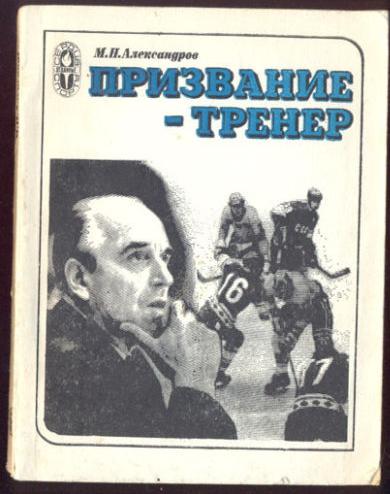
The following book is a biography of Akardy Cherneyshev, the famed coach of Moscow Dynamo. It is written by a fellow named M. Aleksandrov. Published in 1979, this book is over 180 pages and contains over 20 rare black and white photos.


Here's a look inside the book, including a photo of the great coach with the Stanley Cup!


The next book is a biography of the great Sergei Makarov. This book was written by O.Spassky, and published in 1987, when Makarov may have been at the zenith of his greatness. Seriously, there was no doubt he was one of the top ten players in the world at that time, maybe even top 5. He should be in the Hockey Hall of Fame.


The book is 190 pages. Here's a look inside:


Here's another biography, this one about Victor Konovalenko. He was a Soviet goaltender in the days before anyone heard of Vladislav Tretiak. It is no wonder why no one in North America knows about him. This book, titled "Third Period," was published in 1986.


And here's a text on the original Soviet hockey great, Vsevolod Bobrov:


February 6, 2011

Georges Laraque Defends The Bone Cage

In case you have not yet heard, former NHL tough guy Georges Laraque is defending the Canadian novel The Bone Cage by Angie Abdou on CBC Radio's Canada Reads.

Here's a nice article on CBC's website.

The former NHL tough guy is so confident about the book he’ll be defending in this week’s Canada Reads debates, he’s already landing haymakers on the rest of the literary field.

“It’s called Canada Reads. Can-a-da. Which means what book would the majority of Canadians be more attracted to read? And what is the biggest event that the country loves every four years? It’s the Olympics. People love our Olympic athletes.”

“I truly believe the more people who will read this book, the better the support will be for our Canadian athletes,” Laraque said. “Instead of always complaining about the number of medals we’re winning, we’re going to understand the struggle they go through.”

Here's the full story.

February 4, 2011

The Glory Years: Memories of a Decade, 1955-1965 by Billy Harris

I have thoroughly enjoyed Billy Harris' autobiography The Glory Years: Memories of a Decade, 1955-1965.

Published by Prentice Hall Canada back in 1989 Harris gives an insider's view on the Leafs of that era. Harris of course was a utility player on the Leafs in those days, so he definitely qualifies as an insider. He presents the story of his team, coaches and teammates candidly and articulately with a mixture of criticism and wry humor. It is an excellent history of the Leafs of that time frame, with some neat insight on the likes of Punch Imlach, Dick Duff, Bobby Baun, Tim Horton and Frank Mahovlich.

Harris also tells his story from his youth to his years beyond the Leafs. He is a fascinating individual. An academic with many interests and a hockey man who embraced international hockey in a time where it was almost taboo for Canadians to do so, Harris was not your typical jock.

All hockey book enthusiasts know there is a glut of Toronto Maple Leafs books about their glory days. I enjoyed this book so much I would put right near the top of my recommend Leafs history books list.

The book contains many black and white photos, most taken by the author himself. Many of them are humorous as they reveal the hi-jinx and antics of life on a pro sports team back in the 1960s.

February 2, 2011

Hockey E-Book Store - Amazon

Here's a look at Hockey E-Books available at Amazon.com. These e-books are specifically for the Amazon Kindle.


February 1, 2011

More Russian Hockey Books

The other day I shared some amazing photos from a rare Russian hockey book simply titled "Vladislav Tretiak."

I thought now is a good time to look back at a few other books from the Soviet hockey era.

Here is a real rare book from the 1967 World Hockey Championships. It is curiously titled "58:9." The 90 page book consists mostly of 80 black and white colours:


Here's a 158 page book from 1984 about deceased hockey great Valeri Kharlamov:


Here's a cover shot and a look inside of a 1979 book about coaching great Arkady Chernyshev


Here's a rare 1987 book about the great Sergei Makarov. As you can see many great photos lie inside:


Here is Bobby Hull's famous book "My Hockey" released in Russia in 1971:

January 28, 2011

Amazing Photos From Rare Vladislav Tretiak Book

Check out this amazing photo of Vladislav Tretiak and his, ummm..., friends:


Forgive the crease, as I scanned it out of a pretty rare book I recently found at Vancouver Public Library.

"Vladislav Tretiak" was originally published in Russia  in 1978 and revised in 1979. It was compiled by V. Snegirev, designed by A. Litvinenko and featured the photography of M. Botashev, A. Bochinin, D. Donskoy, S. Lidov and Yu. Sokolov.

In 1979 the book was translated into English (by a fellow named Christopher English, oddly enough) and released in North America by Progress Publishers.

The photo-intense book is thin at about 50 pages or so, and features Tretiak's life story including many press-scrum-style quotes from him.

Here's a few more photos from the book:

Tretiak and another of his animal friends - Shamu!


Rare photo evidence of a puck that got past the great netminder:


A great shot of Tretiak's face:


And here he is with his son Dmitry:


In the book Tretiak talks about how as a young boy he wanted to be a pilot. Well here's Vladislav with "The Golden Jet," Bobby Hull:


And lastly, we all know the Soviets were known for their innovative physical training techniques, many of which are now commonplace in the NHL nowadays. Here's one exercise drill that never really caught on over here:


Here are a few written highlights from the book:
  • Q - "What did you want to be when you were a child?" A - "A fighter pilot. Perhaps because my father was a pilot."
  • On deciding he was born to stop pucks - "Once, at the very dawn of his sporting career, Tretiak played forward in the TSKA youth team. Someone had fallen sick and he had to help the team out. He played forward in two matches in the Moscow championship and scored one goal in each. However, when his friend recovered and rejoined the team Vladislav took up his goalie's stick again. By then he had probably understood that this was his true sporting vocation. 
  • His mother introduced him to hockey - My mother is extremely sporting. By profession she's a school P.E. teacher. Before the war she  even played bandy in the Metallurg women's team. It was thanks to her that I developed an early love for the sport. 
  • On his idol - "The finest example of selfless, courageous service of ice hockey is represented for me by the career of Viktor Konovalenko, whose place I took in the USSR team."
  • "Tretiak never plays a stereotyped game. He is like a living computer - first he 'inputs' into his head all the information connected with the state of play, processes it and 'outputs' the right decision, taking account of a number of factors: from which point the goalshot is most likely to be made; which part of the goal the puck will be sent towards; which of this teammates are on the ice at the moment;which of his opponents are attacking. "Aha, Henderson, he'll never try for an intricate shot." "He y, is that Bobby Hull stealing up on me? That means the puck'll be passed to  him and - slam!" "That Martinec with the puck? He'll probably try and dribble it around me." All this information is processed instantly - there is no time to waste, with the puck flying at the speed of an airplane."
  • Q - "Can you tell in advance at which part of the goal a shot is going to be hit, and how hard? A - "I can, as soon as the players swings his stick. It's not often that I get it wrong. I only know two players who were able to flick the puck really hard without a swing, just with the strength of their wrists. These were Anatoli Firsov and  Bobby Hull. I know when Firsov made his famous flicks some goalkeepers simply used to close their eyes.
  • "It would be a mistake to regard all these as a result of Tretiak's sporting talent alone. His interests extend far beyond the ice rink. He graduated with distinction from a P.E. institute and is doing post-graduate work. He is concerned with the psychology of top-level sport, the secrets behind the attainment of supreme skill, and is anxious to determine the limts of human potential. His diaries are full of fascinating and unexpected observations."
  • "By nature sociable and lively, Tretiak avidly attends all new plays and is the possessor of an enviable library. But in general he is a domestic type at heart. He likes to spend his free time romping with his tiny daughter Irina, reading fairy stories to his six year old Dimka, helping his wife with the housework. In the summer, Vladislav and his family head south, to the warmth of the Black Sea."